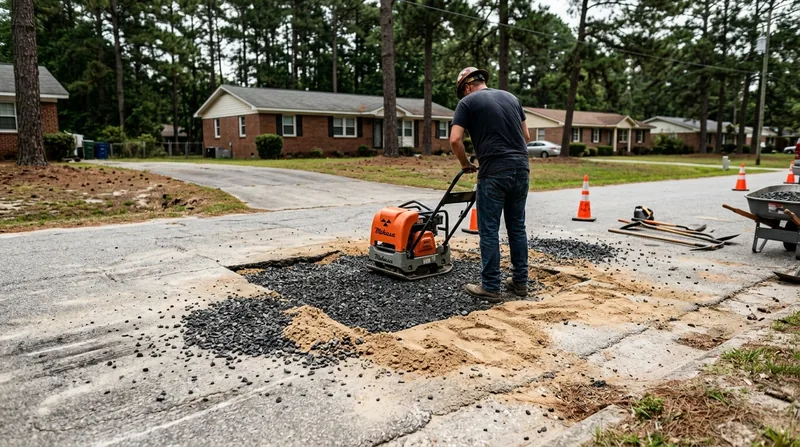




Pothole Repair & Asphalt Patching in Fayetteville starts where the Sandhills sand washes out from under your driveway. Fayetteville's post-war ranch subdivisions and newer developments sit on loose, siliceous sandy soil that drains well but offers little natural confinement to asphalt. When heavy summer downpours pool at low spots or roots from nearby pines work under the surface, the base shifts and the asphalt fails. We saw-cut the damaged area, compact fresh aggregate, and patch with hot mix so the repair holds through the next hard rain. A pothole that starts small can grow fast if left alone, turning a $500 patch into a $2,500 resurfacing job within a season.
Why Pothole Repair Matters in Fayetteville's Sandhills Terrain
Fayetteville sits in the Sandhills, a landscape of old dune ridges shaded by pine forest. That sandy soil is the culprit. Unlike clay or loam, loose sand offers no structural support to asphalt, so water that pools under the surface washes the base away and leaves the slab unsupported. A pothole is not just a cosmetic problem. It grows wider and deeper with each heavy rain and each vehicle that hits it, and a large pothole can damage your suspension, crack a wheel, or catch a foot and become a liability. Early repair is always cheaper than waiting.
- Potholes form where water washes sand from under asphalt, leaving the surface without support.
- Summer downpours in Fayetteville (roughly 52 inches of rain per year) drive most pothole formation.
- A patch applied to solid base material holds reliably and costs far less than letting the damage spread.
- Frost and freeze-thaw are not the primary driver here, unlike northern climates, so seasonal timing is less critical.
Catching a pothole early and patching it right means you avoid the cascade of repair costs that follow.
Local example: A homeowner in a Hope Mills ranch subdivision noticed a small depression in the driveway after a July downpour. Three months later, without repair, the pothole had grown to 18 inches across and 4 inches deep, cracking the surrounding asphalt. What would have cost $450 to patch in August cost $1,200 to patch plus grind and feather the edges by November. The difference is timing and base condition.
For more on driveway damage and repair options, see our driveway repair page.
How We Patch Potholes and Failed Asphalt in Fayetteville
Our pothole repair process starts with a site visit to assess the damage. We measure the failed area, check the base condition, and determine whether a patch will hold or whether the surrounding asphalt is too compromised for patching to work. If the base is solid, we saw-cut the damaged area into a clean rectangle or square, remove the broken asphalt and any loose material, compact fresh aggregate base, and lay hot mix asphalt that bonds to the existing edges. The key is proper compaction of the new base and ensuring the repair is thicker than the surrounding asphalt so traffic wears the patch down evenly rather than leaving a low spot that pools water again.
- We assess the base condition and the extent of damage to confirm that patching is the right fix.
- We saw-cut clean edges around the failed area to create a solid boundary for the new material.
- We remove all broken asphalt and loose base material down to solid ground.
- We compact new aggregate base material in lifts to ensure it supports the asphalt and sheds water.
- We lay hot mix asphalt and compact it so the patch bonds to the existing surface and sheds water away from the repair.
- We allow curing time before the driveway returns to full traffic, typically 24 to 48 hours depending on weather.
The result is a repair that handles the next downpour without failing again.
Raeford example: A parking area for a small commercial property had two potholes near the storm drain where water pooled after heavy rain. We patched both, sloped the repair slightly away from the drain, and compacted the base with a plate compactor to ensure the new asphalt would not settle. Two years later, both patches remain solid and the parking area drains correctly. The repair held because we fixed the drainage problem, not just the asphalt.
If your driveway shows widespread damage across more than 30 to 40 percent of the surface, patching becomes uneconomical and asphalt resurfacing is the better choice.
Pothole Repair & Asphalt Patching Methods in Fayetteville
| Approach | Description | Best for |
|---|---|---|
| Saw-cut and hot mix patch | We cut clean edges around the failed area, remove damaged material and loose base, compact fresh aggregate, and lay hot mix asphalt that bonds to the existing surface. | Single potholes or small failed areas where the surrounding base is solid and the asphalt is otherwise in fair condition. |
| Full-depth patch with edge feathering | For damage that extends deeper or affects a larger area, we remove asphalt and base material, rebuild the base, and feather the new asphalt edges into the existing surface so traffic transitions smoothly. | Larger potholes or areas where the base is partially compromised and the repair needs to blend seamlessly with the surrounding asphalt. |
| Infrared asphalt patching | We heat the edges of the failed area and the new asphalt material so they bond together at the molecular level, creating a monolithic repair with no cold seam. | Repairs where durability and longevity are priorities and the budget allows for a premium technique that eliminates edge failure. |
| Spray injection or slurry seal patching | We clean the pothole, inject a tack coat, and fill with a slurry of asphalt emulsion and aggregate that cures to a solid repair without removing the entire failed section. | Small, shallow potholes or temporary repairs where the surrounding base is sound and the goal is quick turnaround and lower cost. |
Pothole Repair & Asphalt Patching Cost in Fayetteville: What to Expect
Pothole and asphalt patch costs in Fayetteville start at around $450 for a single small pothole with a solid base, and climb based on the size of the failed area, the condition of the base, and the method we use. A larger patch covering 50 to 100 square feet typically runs $600 to $900. Multiple potholes on the same driveway or parking area cost less per patch because we make one trip and can batch the work efficiently. The biggest cost driver is base condition: if the sand under the asphalt is loose or washed out, we spend more time and material rebuilding the base so the patch holds.
We provide a free estimate within 24 hours. We measure the damage on site, assess the base, and give you a firm price for the repair plus a timeline. We never quote a price per square foot; every patch is different, and a number pulled from thin air is not useful to you.
If your driveway has multiple potholes or alligator cracking across more than 30 to 40 percent of the surface, patching is throwing money away and resurfacing or replacement is the smarter investment. We will tell you that on the estimate so you can decide whether to patch now and plan for resurfacing later, or go straight to the larger repair.
Call us at (910) 900-6633 for a free estimate, or visit our pricing page for more detail on how we structure costs for different repair types.
Pothole Repair & Asphalt Patching Near Me: What Fayetteville Homeowners Should Know
When you hire a contractor for pothole repair or asphalt patching in Fayetteville, check that they are fully insured and can show you a certificate of insurance on request. Ask for references from recent jobs in your area, and call at least two of them. Get written estimates from at least two contractors, and make sure each estimate includes the size of the patch, the depth of the base material, and the method they will use. Avoid any contractor who shows up unsolicited at your door, quotes a price over the phone without a site visit, or asks for a large cash deposit upfront. Those are the hallmarks of the itinerant paving scam that has plagued the trade for decades.
If your driveway has an apron (the section where the driveway meets the street), check with the City of Fayetteville or your local municipality before you patch it. Apron work sometimes requires a permit, and the city may have rules about materials or slope. If you live in a master-planned community or an HOA-governed subdivision, confirm with your HOA that asphalt patching is permitted and that the repair method complies with any architectural standards they have set.
We are fully insured, local to Fayetteville, and have been in business since 2014. We provide written estimates with tonnage and material specs so you know exactly what you are getting. Contact us for a free estimate, and we will walk you through the repair options and the cost so you can make the right choice for your driveway.
Pothole Repair & Asphalt Patching in Fayetteville: Pricing Guide
| Service | Price | Details |
|---|---|---|
| Single small pothole (up to 2 feet across) | Starting at $450 | Saw-cut edges, compact base, hot mix patch; includes labor, material, and compaction equipment |
| Medium patch (20 to 50 square feet) | Starting at $600 | Larger failed area or deeper base damage; full-depth removal and base reconstruction included in estimate |
| Large patch or multiple potholes (50+ square feet or 3+ spots) | Starting at $900 | Economy per-patch when we repair several areas in one visit; infrared bonding available as upgrade |
| Base reconstruction or edge feathering | On estimate | If base is compromised or repair needs to blend seamlessly; assessed on site to determine material and labor |
| Travel | Included | Fayetteville and surrounding areas; no separate call-out fee or mileage charge on any job |
| Free estimate | No charge | Response within 24 hours at (910) 900-6633; includes site assessment, written price, and repair timeline |
Indicative pricing, the exact cost depends on square footage, finish, and site access. Free personalized estimate within 24h at (910) 900-6633.


